
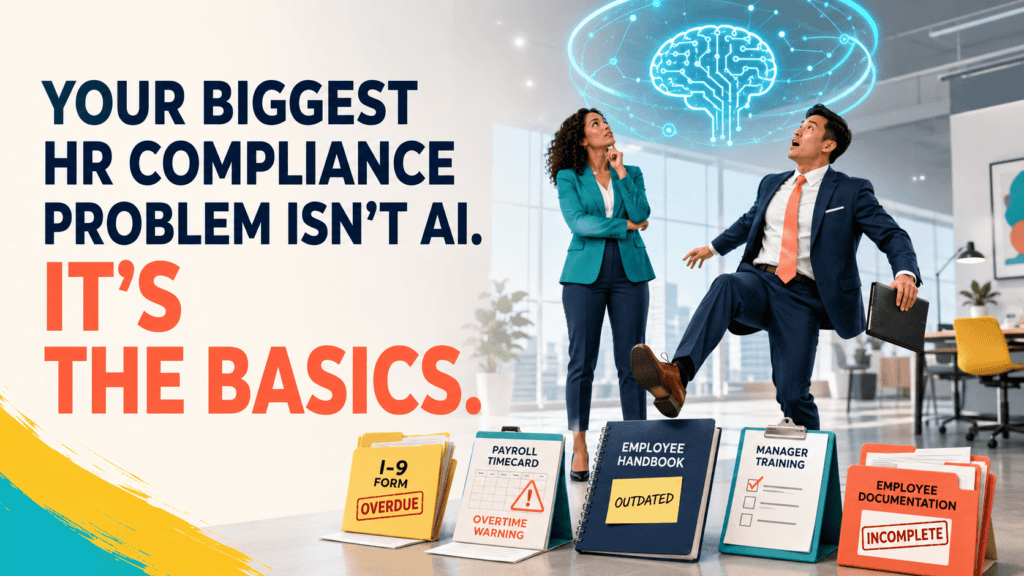
If you attend an HR conference this year, you’ll probably walk away believing the biggest compliance challenge facing employers is artificial intelligence.
- AI policies.
- AI governance.
- AI bias.
- AI regulations.
Those conversations matter. AI is transforming the workplace, and organizations need to understand both its opportunities and its risks.
But, while many leaders are looking skyward at the future of AI, they’re tripping over compliance problems that have been sitting at their feet for years. HR compliance is the ongoing, day-to-day work of following labor laws and employment regulations, including things like wage and hour rules, I-9 employment eligibility verification, accurate handbooks, manager training, and proper documentation. Getting it right means business avoids costly violations, operational friction, and unnecessary risk.
It’s the old problem: The cart is following the horse.
Consider this. In Fiscal Year 2025, the U.S. Department of Labor’s Wage and Hour Division recovered more than $259 million in back wages. This is the highest total since 2019. $146 million of that was tied to overtime violations affecting more than 111,000 workers.
These weren’t futuristic AI failures. They were violations of labor laws that have existed for decades.
For business leaders, HR professionals, and managers responsible for compliance and performance, this is where the real work starts. The issues in this article are the core parts of HR compliance that most organizations still get wrong: wage-and-hour law, I-9s, employee handbooks, manager training, documentation practices, and the operational and cultural fallout that follows when those basics break down.
And those costs aren’t limited to legal settlements. They’re operational, financial, and cultural. They’re preventing businesses from performing at the level they should, and making it harder to adopt new technology well, including AI.
HR Compliance Isn’t an HR Problem
One of the biggest misconceptions in business is that compliance belongs to Human Resources.
That belief is painfully incorrect.
Compliance is a business performance issue. Strong hr compliance reduces legal risk and helps protect a company’s reputation.
When compliance breaks down, operations slow down, managers spend time fixing preventable mistakes, and employees become frustrated. That frustration usually means good people leave, productivity falls, and leaders become distracted by problems they never planned to solve.
Eventually someone says, “HR needs to fix this.” In reality, hr teams help with maintaining compliance across hiring, payroll, workplace safety, and termination by aligning practices with applicable employment laws and federal and state requirements, but they can’t do it alone.
HR didn’t create most of these problems. Poor management practices, inconsistent execution, and outdated processes did. Policies have to be updated continuously to remain compliant as employment laws and workplace practices change. That includes changes to state laws and broader workplace regulations.
And lack of accountability just adds fuel to the already burning fire.
Compliance simply shines a spotlight on operational weaknesses that already existed.
Every dollar spent correcting payroll errors, defending employment claims, replacing employees who leave because of inconsistent management, or responding to government investigations is a dollar that isn’t being invested in customers, innovation, or growth. HR professionals also spend an average of 5.3 hours each month on compliance work, which adds to the operational cost.
The HR Compliance Issues Weighing Companies Down
While executives debate AI policies, these are the other issues quietly pulling organizations underwater.
I-9 Compliance
The Employment Eligibility Verification Form has existed since 1986. Form I-9 verifies a new employee’s identity and work authorization, and employers must complete it for every new hire as part of a the hiring process to stay compliant with applicable employment laws.
Yet employers continue making the same mistakes.
- Missing documentation.
- Late verification.
- Incomplete forms.
- Improper storage.
- Inconsistent procedures.
Employees must present documents proving identity, completed forms should be retained securely and separately from employee files, and errors can lead to serious fines.
None of these errors happen because the law is new. They happen because organizations lack disciplined processes.
An AI recruiting assistant won’t fix that.
Wage and Hour Compliance
Nothing creates expensive problems faster than getting people paid incorrectly, with mistakes such as:
- Employee classification mistakes.
- Failing to pay for all hours worked, including remote work.
- Automatic meal deductions.
- Off-the-clock work.
- Violations of minimum wage and overtime requirements under the Fair Labor Standards Act, or FLSA.
- Managers who ask employees to “just answer a quick email.”
In Fiscal Year 2025, the Department of Labor recovered overtime back wages affecting 110,551 workers. These overtime violations accounted for around four out of every five dollars the agency recovered under the Fair Labor Standards Act in 2025.
Those violations weren’t elaborate fraud schemes, they were everyday management decisions, including:
- A supervisor allowing employees to work before clocking in.
- Workers treated as independent contractors even though the role functions like employment, which can strip people of legal protections and trigger added scrutiny because some states apply additional tests.
- Non-exempt employees not paid for all hours worked and overtime under the FLSA.
- Someone responding to customer emails after hours.
Individually, these decisions seem insignificant, but collectively, they become six- and seven-figure liabilities.
Final wages are another wage-and-hour risk area governed by state laws, and in many states they must be paid on the next regular pay date. Some states require same-day or near-immediate payment for terminated employees.
Employee Handbooks That No Longer Reflect Reality
Many organizations proudly say they have an employee handbook, and they even give it to every new hire who joins their company. Then you read it and find policies are out of date and it reference systems that no longer exist and benefits changed years ago.
Managers ignore half the policies because nobody remembers writing them, and the handbook becomes something that sits in a digital folder until litigation begins, and it will.
A handbook should describe how your organization actually operates today. If it doesn’t, it doesn’t protect anyone, and keeping it current also supports statutory compliance.
Manager Training
This may be the single largest compliance risk in most organizations. Managers make hundreds of employment decisions every year:
- Hiring.
- Scheduling.
- Discipline.
- Performance.
- Leave administration.
- Accommodation.
- Termination.
Yet, most receive little formal training in employment law, proper documentation, or employee compliance, even though regular compliance training is proven to help prevent discrimination and harassment.
Title VII of the Civil Rights Act, enacted in 1964, the Age Discrimination in Employment Act, which protects employees aged 40 and older, and the Americans with Disabilities Act, enacted in 1990, prohibit discrimination based on protected traits, including national origin and age discrimination. The Equal Employment Opportunity Commission also enforces the Genetic Information Nondiscrimination Act, the Pregnancy Discrimination Act, and the Pregnant Workers Fairness Act.
In Fiscal Year 2025, the EEOC processed 88,201 new charges of discrimination and resolved 90,743 charges. Its Office of General Counsel reported that retaliation and constructive discharge were, by far, the most frequent allegations in the lawsuits the agency filed that year.
That isn’t because managers intentionally retaliate. It’s because many don’t recognize when an employee has engaged in legally protected activity. A poorly timed write-up, schedule change, or termination that appears routine to a supervisor can look quite different to a federal investigator.
HR also plays a critical role in building compliant hiring processes, from avoiding discriminatory language tied to protected classes in job listings to making sure interviewers understand anti-discrimination laws and avoid disability-related questions during the hiring process. Interview and selection practices also need to align with applicable laws.
Good intentions are not a compliance strategy. Well-trained managers are.
Documentation
Employment attorneys often repeat one simple phrase:
“If it isn’t documented, it didn’t happen.”
Yet documentation is one of the first things managers stop doing when business gets busy. Performance conversations disappear and attendance problems go undocumented. Corrective actions become verbal conversations remembered differently by everyone involved.
Months later, when an employment decision has to be defended, the evidence simply doesn’t exist.
This is why regular compliance audits matter; they help protect employee rights and company reputation. Hr compliance reports can also track recurring hr compliance issues and confirm adherence to workplace safety regulations.
Consider this example:
Recently, we worked with an organization that believed its biggest HR challenge was determining how AI would affect recruiting.
As we began our assessment, we found things requiring much more immediate attention:
- Managers were inconsistently approving overtime.
- Timecard edits lacked documentation.
- Employee files were incomplete.
- Performance conversations rarely made it into writing.
While none of these issues had resulted in litigation, every one of them represented operational friction, inconsistent management, and unnecessary financial exposure.
Instead of beginning with AI governance, we strengthened management practices, documentation standards, payroll controls, and policy execution.
Only then did technology become an accelerator instead of a distraction.
That’s the difference between chasing technology and building operational excellence.
Technology Isn’t the Problem
Technology often gets blamed for changing the workplace, but the right hr technology can help improve hr compliance and even ensure compliance through automation when the basics are sound.
In reality, technology usually exposes weaknesses that already exist. For example:
- Poor data becomes visible faster.
- Broken processes fail more dramatically.
- Inconsistent decisions become easier to identify.
Technology should support hr compliance efforts across the entire employee lifecycle, not mask weak processes. That includes following hr compliance best practices for data security, privacy, and process consistency.
AI may represent a new problem, but most organizations haven’t solved the old ones yet.
Imagine building a second story onto a house with a cracked foundation. The second story isn’t the problem. The foundation is the weakness.
The Hidden Cost of Poor Compliance with the Equal Pay Act
Many leaders secretly calculate compliance risk by asking one question:
“What happens if we get caught?”
The better question is:
“What has poor compliance already cost us?” Poor compliance often reflects missed obligations under employment act requirements and related pay-equity rules, including the Equal Pay Act (EPA).
Consider the hidden expenses:
- Turnover because managers apply policies inconsistently.
- Payroll corrections that consume HR and Finance resources.
- Hours responding to agency investigations over workers’ compensation coverage gaps, since employers must maintain workers’ compensation insurance in most states.
- Legal reviews that could have been avoided after errors in FMLA administration, even though FMLA provides job-protected leave for eligible employees under federal employment laws, or after failing to provide paid sick days where required under California’s Paid Sick Leave law.
- Delayed promotions because documentation is missing.
- Recruiting costs to replace employees who lost confidence in leadership after discrimination complaints involving protected classes or workplace safety concerns.
- Management time spent fixing preventable problems instead of growing the business.
Those costs rarely appear on a compliance dashboard, but they definitely appear on your income statement.
Compliance Creates Performance: The Role of the Employee Handbook
Organizations often treat compliance like insurance: something you buy because you have to.
That mindset misses its greatest value. Well-run compliance systems create better businesses.
A strong hr compliance program should cover the employee lifecycle from hiring through termination, while also accounting for labor relations obligations under the National Labor Relations Act.
- Clear policies create consistency.
- Consistent managers build trust.
- Trust improves retention.
- Better retention reduces recruiting costs.
- Accurate payroll improves morale.
- Reliable documentation supports better decisions.
- Well-designed processes eliminate unnecessary work.
The result isn’t simply fewer lawsuits; it’s higher-performing organizations. Compliance isn’t about avoiding penalties, it’s about removing friction. Every compliance failure creates drag, and every improved process creates capacity.
None of this means organizations should ignore artificial intelligence; far from it.
AI governance, privacy, bias, intellectual property, and emerging regulations deserve serious attention, but they deserve attention after you’ve confirmed your fundamentals are sound.
A company with inconsistent hiring practices doesn’t become compliant because it writes an AI policy. A manager who doesn’t understand overtime law won’t suddenly become compliant because they use AI to build schedules.
Technology should accelerate strong processes, but it will never replace them.
HR Compliance FAQs: Before You Chase the Future
Use an hr compliance checklist and ask yourself a few uncomfortable questions.
- Are your I-9s audit ready?
- Are your employee classifications correct?
- Do your managers understand wage and hour laws?
- Does your handbook reflect how your business actually operates?
- Are employee files complete?
- Can you defend every termination decision with documentation?
- Do your supervisors receive regular compliance training?
- Have you reviewed federal state and local employment laws, and do current practices align with anti-discrimination and pay-equity requirements?
If any of those questions give you pause, that’s where your attention belongs, whether through compliance support from an hr compliance specialist, an employment attorney, or your hr leaders.
AI may change how work gets done, but compliance determines whether the work is done well.
Organizations that master the fundamentals will adopt AI faster because they’ll have disciplined managers, reliable data, documented processes, and operational consistency.
Organizations that ignore the fundamentals will simply automate their existing problems, meaning mistakes will happen automatically and faster than ever before.
Before you ask how AI will transform your business, ask whether your business is ready for AI.
The answer has less to do with technology than most leaders think.
At Peoplyst, we believe compliance is more than checking boxes or avoiding fines. It is one of the clearest indicators of operational health. Organizations with strong compliance foundations don’t just reduce risk. They build better managers, create better employee experiences, and operate with greater consistency and confidence. If you’re wondering whether hidden compliance issues are quietly limiting your organization’s performance, Schedule a call with us. We’d be happy to have a conversation and share some practical advice about removing the obstacles holding your business back.
Connect with Tearle Johnson on LinkedIn for more content on HR Operations and Compliance Support.