

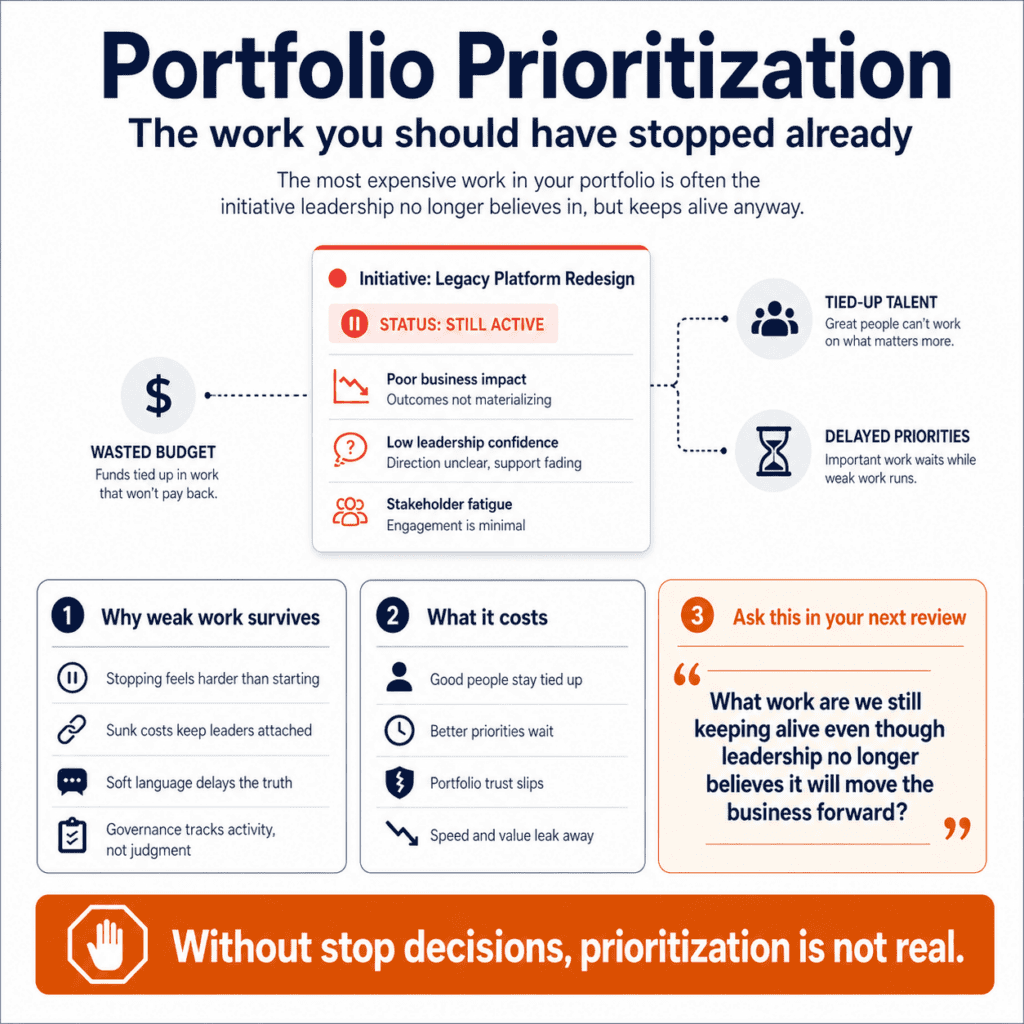
The work is still funded.
And that is exactly why portfolio prioritization gets exposed in the real world. It’s not the moment leaders pick what to start. It’s when they have to decide what no longer deserves to survive.
You know the project. The one that’s still on the review agenda, and people’s names are still attached to it. Someone is building the update deck. Someone else is walking the room through the status. Even worse, the timeline keeps asking for more time.
And somewhere underneath all of that, the conviction is already fading. No one may have said it out loud yet, because the business case may have weakened slowly enough that nobody wanted to own the moment it stopped being worth it. The sponsor may already be onto something else, but the work is still there because no one will make the call to end it.
That’s some of the most expensive work in the portfolio. Everyone sees it failing, but it’s tolerated anyway.
A lot of leadership teams talk about portfolio prioritization like the problem is figuring out what matters most, but they already know more than they want to admit.
They can see which work has lost momentum and which program is taking up more than it is likely to give back, but ending it requires more effort and explanation than they’re willing to give.
So the work stays alive. Shared resources keep getting dragged into updates, issue logs, steering meetings, budget reviews, and another round of replanning for work that’s getting more protection than it has earned. Meanwhile, better priorities wait. Credibility starts to slip, the portfolio gets heavier, and the business slows. Everyone says the company is trying to focus, but the choices say otherwise.
This is where value starts leaking, in the long hesitation before someone finally decides enough is enough.
Why Weak Work Survives Portfolio Prioritization Longer Than It Should
Most organizations don’t keep weak work alive because they are careless. They keep it alive because stopping work is harder than starting it, especially once senior leaders have attached their names to it.
It forces executives to face sunk costs. It forces them to admit the assumptions changed, the environment moved, the return weakened, or the initiative should never have made it this far in the first place. It’s an ownership issue, and a lot of teams wait too long to take it.
I’ve seen this happen in large portfolios, remediation work, transformation programs, growth pushes, integrations, and strategic initiatives that once looked important enough to protect at all costs.
At first, no one wants to overreact. Then the language gets softer. The initiative isn’t failing, it just needs to be reassessed. It’s not off track, it just needs to be recalibrated. It’s not losing support, it’s evolving. That kind of language gives people cover while the business keeps avoiding the truth.
The underlying truth usually stays the same. Leadership is no longer convinced the work will move the business as it once expected, but ending it feels more painful than letting it continue. So it does.
What This Looks Like Inside An Executive Team
The signs are usually there long before anyone wants to deal with them. The sponsor is less engaged than they were six months ago. The same issues keep coming back into the room. And the work is still waiting on things that should have been resolved by now.
The team needs another scope adjustment, a timeline reset, more funding, or just one more explanation for why the benefit will show up later. Then the change request gets approved, the status goes green again, and everyone acts like something was actually fixed. The reporting says one thing, but the room feels another.
I’ve sat in reviews where the deck looked healthier than the executive conversation. On paper, the program was manageable, but in reality, no one at the table wanted to put any real belief behind it anymore. They were funding it and asking for updates, but they were no longer making decisions like leaders who believed the work was central to the business.
That’s often the tell.
Once leadership stops showing up like owners, the work can keep looking alive in the deck long after it stopped earning its place in the business.
The Cost is Bigger Than The Line Item
When weak work stays alive too long, most teams go straight to the obvious cost. Budget, vendor spend, headcount, or delivery cost. That part is easy to see. What gets missed is everything this work keeps holding up.
Good people stay tied up on work leadership already has doubts about. Better priorities wait because no one cleared the space for them.
Teams learn that priorities rarely get narrowed in practice, no matter what leadership says. Portfolio trust starts slipping, and they become more cautious about escalation. They waste energy trying to figure out which priorities are real and which ones are only hanging around because leadership never closed the door.
Poor portfolio prioritization is rarely just a volume problem. More often, it’s leadership refusing to take work out of play. Without stop decisions, prioritization is not real.
Why Governance Often Makes This Worse
This is where governance can start protecting the wrong work.
A lot of governance structures are built to track activity, but they don’t force judgment.
Leaders get status, risks, dependencies, and burn rates, so the meeting looks productive and disciplined instead of becoming the kind of operating cadence that actually forces decisions.
Why are we still doing this?
It’s not a PMO or an EPMO problem. I say that carefully because strong portfolio governance matters. Strong PMOs and EPMOs matter. This is purely a leadership problem.
Delivery predictability is the price of entry. It is not the finish line.
But good reporting doesn’t make the decision for you. And once leadership keeps putting that work back on the agenda, governance stops protecting value and starts giving the work cover.
The Stop Decision Is Rarely Clean
This is one reason leaders avoid it.
Most of the time, the answer is not as simple as stopping the work on the spot. The better call may be to cut the scope or move the work into business-as-usual. Sometimes it’s wise to pause it and force the team to come back with a case that still holds up.
That’s where leaders start buying themselves more time than they should. The nuance is real, but the problem is what people do with it. A lot of organizations use that gray space to keep weak work alive longer than it deserves.
Portfolio reviews exist to force the decision while the business still has something worth saving.
Call the work what it is. Then decide whether it earns any more time.
What Strong Leadership Teams Do Differently
Strong leadership teams deal with the work earlier.
They don’t wait for the business case to fully collapse or for the initiative to become embarrassing to defend. They look at what the work is taking up and decide whether it still deserves room in the portfolio.
Then they make a call people will notice.
After a while, everyone knows whether leadership is serious about narrowing the work or just talking about it. That’s where confidence starts to hold or slip.
A Better Question For Your Next Portfolio Review
It’s time to be honest. Ask:
What work are we still keeping alive even though leadership no longer really believes it will move the business forward?
Or ask it this way. What in this portfolio is being protected by process more than by belief?
Answer those questions with integrity, and then act on the answer quickly.
The Businesses That Move Faster Are Not Always Doing Less Work
They are usually clearer about what no longer deserves to stay alive.
The most expensive work in the portfolio is often not the initiative that’s visibly broken. It’s the one that still looks respectable enough to keep going while it keeps taking more from the business than it deserves.
About the Author
This article was written by Erica Howard, Chief Strategy Officer at Peoplyst and former Fortune 100 strategy and governance executive. Erica has more than 25 years of experience helping organizations strengthen strategy execution, portfolio governance, value realization, and operating model design across high-stakes priorities. She is known for building practical execution systems that connect strategy, prioritization, funding, accountability, governance, and measurable business outcomes.
Fact Checked & Verified
This content is part of Peoplyst’s commitment to practical, accurate guidance. You can find more of Erica Howard’s insights on LinkedIn or learn more about Peoplyst’s approach on our Strategy Execution and Value Realization page.
Have a question about how this applies to your business, or want to discuss how Peoplyst can help?
Schedule a brief strategy call with Erica.