

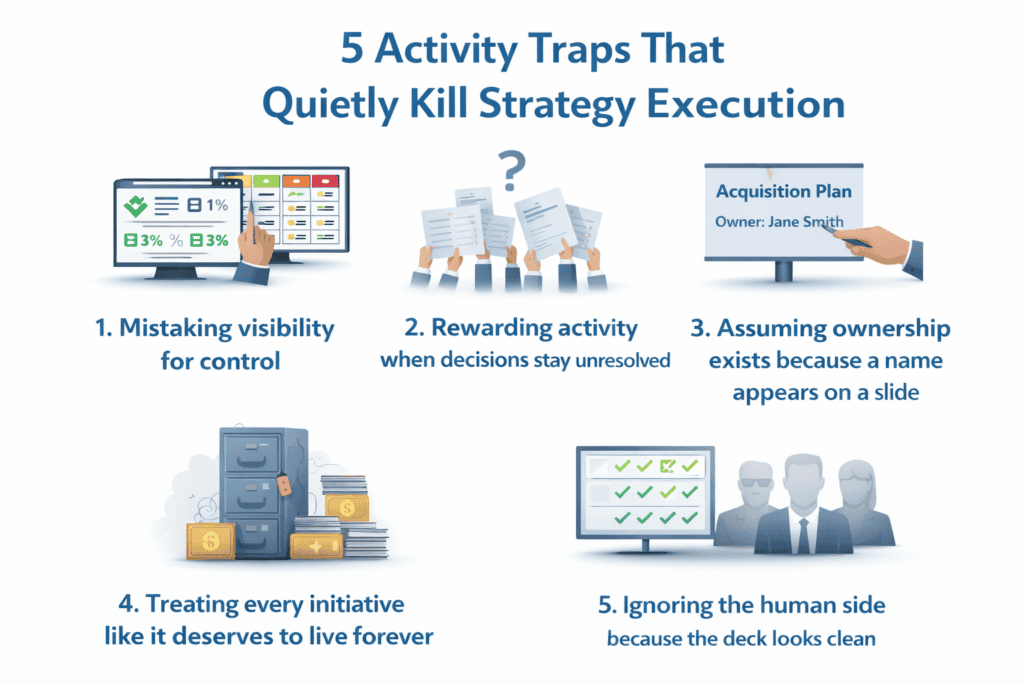
How to spot the 5 activity traps that quietly kill value realization
A lot of companies are not struggling because people aren’t working hard. They’re struggling because all that activity isn’t moving the business forward.
Calendars are packed. Leaders are getting updates. Teams are pushing to hit dates. On the surface, it looks like strategy execution is moving.
A lot of the time, it isn’t.
That’s the gap more leaders need to pay attention to.
Once an organization starts confusing visible activity with real progress, value begins leaking quietly. Not through one dramatic failure, but through a steady buildup of small misses, unresolved decisions, delayed tradeoffs, fuzzy ownership, and work that keeps moving without producing the result it was meant to.
This is where strategy execution gets expensive.
I’ve seen this pattern repeat across large, complex portfolios, and it is one of the fastest ways value starts slipping while leadership still thinks execution is on track. It’s often the same pattern from How to Address Productivity Issues Without Micromanaging, where visible activity can mask deeper problems in clarity, ownership, and decision-making. It shows up in acquisitions, launches, remediation work, portfolio resets, regulatory programs, business transformations, and new operating models. These are the kinds of efforts where leadership cannot afford to confuse motion with progress.
Busy isn’t a strategy. It’s what happens when the organization hasn’t made the hard decisions required to deliver.
A full pipeline doesn’t mean the work that matters is advancing. A crowded steering committee doesn’t mean governance is working. And a green status report doesn’t mean accountability exists or value is being realized.
Why activity vs progress is a leadership problem
The core issue isn’t effort. The issue is leadership discipline.
When leaders review execution through activity alone, teams learn how to show movement without proving outcomes. Delivery metrics still matter, but they cannot be the only lens. Scope, timeline, and budget tell part of the story. They don’t tell you whether the business actually changed.
And those are the questions that actually matter.
Did adoption move? Did cycle time improve? Did risk go down? Did the customer experience improve? Did the business capture value? Did the work solve the problem it was supposed to solve?
If the answer is vague, the issue isn’t reporting. It’s execution.
Trap #1: Mistaking visibility for control
Leaders usually feel better when they can see a lot of activity. There’s no shortage of meetings, milestones, templates, dependencies, action items, weekly/monthly reviews, executive steering committee decks…the list goes on.
Those items give leaders something to look at, but they don’t always tell them what’s really happening. Dashboards can look healthy, and governance can look tight, yet business outcomes remain flat.
That false signal is one of the most damaging patterns in strategy execution. A team can show that a program is on time, on budget, and low risk. Then a harder question shows up. What changed in the business because of it?
Too often, the answer is unclear… or the answer is nothing.
Trap #2: Rewarding activity when the real problem is unresolved decisions
Most stalled initiatives stall because the organization keeps pushing off a decision the work needs in order to move.
Usually, the questions are predictable. What takes priority? Who owns the dependency? What gets funded now? What waits? What needs to stop? What needs to be rescoped? What outcome is the work supposed to move? Who has the authority to step in when something is off track?
When those questions sit too long, activity fills the gap.
People schedule more meetings because they can’t get decisions. They produce more reports because they can’t get clarity. They create more governance because they can’t get accountability. The work looks alive, but it is operating around the problem instead of through it.
That is why a Weekly Operating Cadence matters so much. Governance earns its place only when it accelerates decision-making. When it starts manufacturing paperwork, it becomes overhead.
Trap #3: Assuming ownership exists because a name appears on a slide
Something isn’t owned because it showed up on a slide. It’s owned when the person whose name is attached to it has real control over what happens next.
A lot of organizations spread accountability so widely that nobody is really integrating the work. Finance is managing planning. The business is setting priorities. Technology is focused on delivery. PMO is tracking status. Change is driving adoption. Risk covers controls. HR is handling organizational impacts.
All of that work matters.
But when nobody is integrating it, the business still feels disconnected. That’s usually when leaders start asking why the business hasn’t moved, even though everyone seems busy.
The activity was there, but real ownership was not.
Trap #4: Treating every initiative like it deserves to live forever
A lot of work keeps going for one reason. It’s already in motion.
The project was approved years ago and keeps getting funded because the teams are there and the work is already underway. Nobody wants the friction of changing direction or being the one to say it should slow down, be cut back, or move into business as usual.
That’s how organizations end up with active work that no longer deserves the same level of time, money, or attention.
This is where value starts to get diluted. Leadership has to step back and make harder calls across the full slate of work. What still deserves resources? What can wait? What no longer earns the same level of support?
If everything stays a priority, nothing finishes cleanly.
Trap #5: Ignoring the human side because the deck looks clean
A transformation can look healthy on paper while losing execution capacity in real time.
High performers burn out. Key leaders disengage. Teams stop escalating bad news. Adoption slows. Cross-functional friction builds. People get tired of hearing one message while living another.
As I wrote in The Hard Truth About Strategy Execution, people issues show up fast in execution. And as I wrote in Synergy Capture: Why Targets Get Missed After the Deal Closes, value starts slipping the minute leadership underestimates what people need in order to execute through change.
These aren’t soft issues. They’re straight up execution risks.
If leaders can’t create enough trust for teams to raise issues early, stay aligned through pressure, and keep moving through change, the work will start slipping, no matter how clean the deck looks. That is also why Leadership Development: How To Build Leaders Who Actually Improve Performance matters so much. Execution gets stronger when leaders know how to create clarity, build trust, and keep people moving through pressure.
What this looks like in real life
You can usually tell when an organization is busy but not really delivering.
Priorities keep moving. The same issues stay open. Dashboards show status, but leaders still can’t say what value has actually been realized. Teams produce more reporting because decisions are weak or delayed. Everything feels urgent, but very little finishes with a clean business impact.
If that sounds familiar, the issue isn’t effort. It’s how execution is being led.
What strong leaders do differently
Strong leaders don’t get distracted by visible activity. They want to know what’s changed in the business, what’s still getting in the way, and where leadership needs to step in before more time and value get burned.
They create a leadership rhythm that earns its place. Not one more meeting or another deck, but a real way to review the work that surfaces blockers, forces decisions, protects capacity, and keeps execution tied to business results.
Delivering organizations make choices. They clear the path. They stop funding work that no longer earns it. They stay close enough to the truth to act before drift turns into loss. That matters even more now, because the work is not getting simpler. It is getting more cross functional, more scrutinized, and more expensive to get wrong.
Final takeaway
Full calendars don’t tell you much. Neither do thick decks or a sea of green status dashboards.
The real questions are much simpler:
- Is the business actually moving?
- Is ownership clear?
- Are leaders making the decisions this work requires?
Those answers are table stakes.
In the end, the market does not reward how busy an organization looks. It rewards what the business actually delivered.
Let’s partner for success
If execution is slipping, ownership is unclear, or the business is staying busy without moving results, that usually is not a reporting problem. It is a leadership and operating discipline problem. That is the work Peoplyst helps companies fix.
Learn more at Strategy Execution and Value Realization
Or connect with me on LinkedIn.