
The deal closes. The press release goes out. The model looks strong, but then execution takes over.
Over 60% of deals since 2010 have missed publicly announced synergy targets. That is not a rounding error. It is a systemic value realization problem that destroys billions of dollars in expected deal value every year. Smart companies still miss synergy targets all the time. The real questions are: why do they keep missing it, and what do strong acquirers do before and after close to protect value?
Most deals don’t miss synergy targets because the model was wrong. They miss them after close, when the organization has to turn assumptions into execution, and the work starts to slow where it matters most. Leaders carry too many assumptions into close that the business was never set up to deliver. The model doesn’t translate cleanly into an owner-based integration plan. That ownership gap is the same one I wrote about in The Hard Truth About Strategy Execution, because once ownership gets fuzzy, execution almost always starts to drift. Complexity gets underestimated, and accountability starts to drift once the work is underway.
This is where expected value starts separating from realized value.
Synergy capture is the disciplined work of turning expected value into real P&L impact. On paper, that sounds simple. In practice, this is where many deals quietly underperform.
This is not just a tracking issue. It is an execution issue.
It’s where strong acquirers protect value, and where weaker ones start giving it back.
What gets modeled is rarely the problem
Most deals are built around familiar categories of synergy: cost, revenue, and financial. That part isn’t complicated. The problem starts when leaders mistake a clean model for a credible path to delivery.
Cost synergies usually look the most concrete, which makes teams overconfident. Revenue synergies usually sound the most exciting, which makes teams overpromise. Financial synergies can strengthen the deal case, but they do not fix weak execution after close.
The categories are familiar, and the miss usually is too. A model can point to value, but it can’t deliver it.
Where synergy capture breaks down
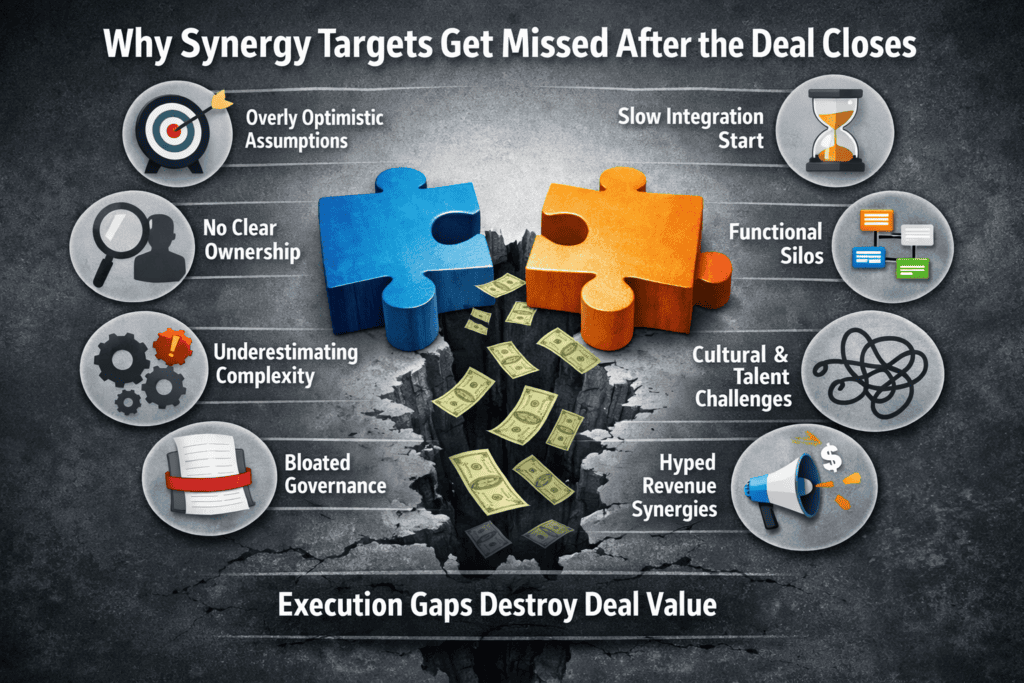
Most missed targets don’t come from one dramatic mistake. Instead, they come from a set of predictable breakdowns that show up again and again after close.
Different deals have different pressure points, but the pattern underneath them is usually the same. The organization never built a strong post-close execution model capable of turning deal value into real business results.
1. Assumptions were too optimistic before close
This starts earlier than most leaders want to admit. When pressure builds to make the economics work, the assumptions start stretching with it. Savings get counted twice. Timelines get compressed to fit the story. One-time costs get minimized or pushed aside. Revenue synergies are modeled as if customers move faster than they do in the real world.
That’s where the first gap opens.
A procurement savings may show up in two places. An ERP integration is modeled for 12 months, even though experienced operators know it may take at least 24 to 36 months. The one-time cost to capture savings gets treated like a footnote, even when it can run close to the annual benefit. This doesn’t mean the deal thesis was wrong. It means leaders have to separate ambition from operating reality before closing, not after it.
Strong acquirers do that early. They use ranges instead of false precision. They test timing and challenge overlap. They ask what has to be true for the number to hold.
Because once the deal closes, optimism does not carry the work. Execution does.
2. Teams wait too long to start serious integration planning
Every month lost after close narrows the runway for synergy capture. Some organizations wait too long to move into disciplined execution. They wait for approvals, org clarity, or leadership decisions. Others tell themselves the business needs time to settle first. Meanwhile, the clock on synergy targets keeps moving, whether the work is ready or not.
That is why delay gets expensive fast. The deal model usually assumes an early start, but the business often acts like it has more time than it actually does.
Strong acquirers do not confuse legal close with execution start. They build momentum before close, tighten assumptions during sign-to-close, and move quickly once the deal lands.
Speed matters. Disciplined momentum is what protects the value.
3. Model gets approved, but the real work doesn’t have an owner
This is where a lot of value starts slipping. The board approves a model with clean numbers and attractive run-rate savings. Then the integration team inherits targets that sound precise in finance language and vague everywhere else.
An $80 million general and administrative cost synergy is not actionable on its own. Neither is a revenue growth assumption tied to cross-sell. Those numbers only become real when someone translates them into initiatives, owners, milestones, dependencies, and timing that can be managed week by week. Too often, that translation never gets finished.
The deal team steps out, and the integration team steps in. Business leaders start treating synergy targets as finance numbers in scorecards rather than as operating commitments. The organization runs workshops, builds slides, and tells itself it has a plan, but too often, what it really has is a handoff gap.
Strong acquirers close that gap fast by building a real synergy register before Day 1 or immediately after close. Every line item gets tied to a named owner, a P&L linkage, key milestones, and a clear dependency path. It becomes a working execution tool, not a reporting artifact.
That’s when a target stops being deal math and starts becoming real operating work.
4. Integration gets organized around functions instead of P&L
This sounds like a design choice, but it quickly becomes a value problem. Many integrations get built around workstreams like IT, HR, Finance, Legal, and Operations. That can help manage activity. It does not always help manage value. A workstream can hit most of its milestones but still miss the expected P&L impact. That is how organizations end up celebrating progress while missing the number.
A stronger approach is to connect initiatives directly to value drivers, revenue, cost of goods sold, SG&A, or working capital. When an initiative maps to a specific line, sits with a leader accountable for that line, and gets tracked through financial impact, the conversation changes.
That is also when bloated program management gets exposed. A results management office can help the organization see what is moving the numbers and what is just consuming time. The scorecard should not live only in the integration dashboard. It should show up in the financials. That is when the work stops being organized around activity and starts being organized around value.
That shift matters because once the work is tied to the P&L, complexity gets harder to ignore.
5. What looks manageable on paper gets complicated fast
This is where deals can look stable at the top while value starts slipping underneath. A synergy may sound simple in the model, but in business, it rarely is. What looks like a single decision on paper often depends on systems, legal entities, customer migration, vendor contracts, workforce changes, and adoption across multiple teams.
A logistics synergy may require network redesign, technology changes, contract updates, customer movement, and continuity safeguards. A systems consolidation may depend on clean data, sequencing, risk controls, regulatory requirements, and frontline adoption. None of that stays simple once the work begins.
Then capacity becomes the next problem.
The same leaders are expected to run their businesses and integrate them. The same subject matter experts get pulled into core operations, transformation work, remediation efforts, and synergy initiatives all at the same time. Everything is urgent. Everything is critical. That’s usually when delay starts making decisions for leadership.
This is rarely an effort problem. It’s a leadership tradeoff problem, and most organizations don’t face it until value is already slipping.
6. Governance gets heavy fast and starts adding noise
A lot of organizations respond to integration risk by adding more governance, which means more meetings, templates, decks, status reporting, and RAG colors on a dashboard. None of that creates control. Most of it just creates noise.
If the same data is reported in multiple formats, if meetings review status rather than forcing decisions, and if red items trigger an explanation rather than intervention, the organization is not managing synergy capture. It is documenting drift.
| What you see | What’s really going on | What it’s costing you |
| Status updates keep increasing | Governance is built to report activity, not force decisions | Leaders still can’t see what needs to change now |
| Dashboards are full of red, yellow, and green status | Risk is being tracked, but not tied to value realization | Teams know something is off, but don’t monitor or track where value is slipping |
| Meetings happen every week, but the same issues stay open | Dependencies are visible, but no one is resolving them | Execution slows and critical work stays blocked |
| Workstreams look active | Accountability for outcomes is still unclear | Progress gets reported, but ownership stays fuzzy |
| Reporting volume keeps growing | Governance is rewarding updates instead of intervention | The organization gets more noise and less control |
This is what typical governance failure looks like. The reporting goes up, but clarity doesn’t.
Good governance earns its place by doing something useful. It reallocates capacity. It resolves dependencies. It changes the sequence. It escalates blocked decisions. It stops work that no longer makes sense. It gives leaders clear visibility into risk, timing, interdependencies, and value realization. Anything less is simply overhead.
This is where governance stops helping and starts slowing down the work. That is also why a real weekly operating cadence matters so much. The right rhythm does not create more reporting. It creates better decisions.
7. Culture, talent loss, and change fatigue hit harder than leaders expect
These issues get dismissed as “soft” far too often, and there is nothing soft about losing execution capacity. This is also where leadership development stops being a separate conversation and starts showing up in execution, retention, and performance.
When two companies come together, they bring different norms, decision styles, incentives, and levels of risk tolerance. If leadership does not address that directly, synergy capture slows fast. Revenue synergies are especially exposed because they depend on customer trust, commercial coordination, and leaders who can keep talent focused through uncertainty.
When key leaders leave, high performers stop raising issues, and teams get tired of hearing one message while living another, the business loses more than morale. It loses momentum and operating discipline.
That matters because integration depends on people making thousands of decisions under pressure. If those people are distracted, skeptical, or halfway out the door, the quality of those decisions drops, and value starts slipping with it. Retention plans, role clarity, and a credible integration narrative are not side work. They are part of the execution model.
This is where culture stops sounding abstract and starts showing up in the numbers. And once culture starts showing up in the numbers, revenue synergies are usually the first place the gap becomes impossible to ignore.
8. Revenue synergies get sold hard but are managed too loosely
Cost synergies are usually easier to size. Revenue synergies are easier to talk up. Cross-sell, pricing power, market expansion, and broader customer access all sound good in the model. It means very little if customers do not respond after close the way leadership assumed they would. This is where a lot of revenue promises start to break down.
That breakdown usually starts when leaders treat revenue synergies like upside in the deck rather than treating them as operating work in the business. The customer view is fragmented, and client needs may differ across entities in ways that reshape go-to-market priorities after close. Account ownership is not clear. Incentives are misaligned. The commercial plan is thin. Sequencing is weak. Adoption gets assumed instead of led.
That is why strong acquirers stay more conservative here. They know revenue synergies usually take longer to materialize and carry more customer, talent, and execution risk. They don’t announce year-one wins just because the spreadsheet can carry them. They earn them. That means getting the commercial integration right, establishing clear revenue ownership, aligning incentives, deciding how accounts will be covered, and ensuring the customer experience works before anyone starts counting upside.
That is when revenue synergy stops being a promise in a deck and starts becoming a commercial execution test.
Different deals. Same execution problem.
Not every deal misses for the same reason.
Some deals break under the weight of consolidation. Others lose value when key talent walks, local customer dynamics don’t transfer, or the integration platform can’t carry the load. The pressure point may change, but the execution problem usually does not.
Value slips when leaders ask the integration model to carry more than it was built to handle.
What strong acquirers do differently
Strong acquirers do not treat synergy capture like a finance exercise that gets handed off after close. They treat it like operating discipline.
| What strong acquirers do | What that means in the business |
| Test assumptions early | Don’t carry weak assumptions into close and hope execution fixes them. Pressure-test timing, overlap, and one-time cost assumptions before close, and keep testing them in stages instead of handing them off once and hoping for the best |
| Start early | Build momentum before close and keep it moving after the deal closes |
| Involve future owners early | Bring in leaders who will have to deliver the value before ownership gets fuzzy |
| Put real owners in place | Ensure every major synergy line has a clear owner and a direct link to the P&L |
| Build an owner-based synergy register | Map each target to a named owner, milestone path, dependency path, and P&L line |
| Organize around value | Tie work to business results, not just functions, meetings, or activity |
| Use governance that helps | Govern to clear blockers, force decisions, and keep work moving |
| Protect the human side | Treat retention, role clarity, and change adoption like execution risks by making retention decisions early, communicating leadership roles quickly, and ensuring people know what the business expects from them |
| Earn revenue synergy | Build commercial integration before anyone starts counting upside |
| Track value through the business | Use real business outcomes, not just a dashboard, and keep reviewing the work until the synergies are visible in the business |
What strong acquirers understand
This is where deals either protect value or start giving it back. It’s never in one dramatic miss, but it begins to surface in the small execution failures that start to pile up after close.
Final thought
Synergy targets don’t usually get missed because the value was never there. They get missed because too many companies still assume the business will sort it out after close.
But it won’t.
That’s why experience matters. Strong acquirers know the model is only the starting point. The real work is turning assumptions into ownership, decisions, momentum, and business results that show up in the P&L.
That gap between promised value and realized value is not bad luck. It is usually the result of leadership choices made too late, tradeoffs avoided too long, and execution discipline that was never strong enough when the pressure actually hit.
If you are in a deal now, or planning one, pay attention to the places where value starts slipping before the numbers make it obvious. That is usually where the real problem is.
By the time the miss shows up in the numbers, the value is already harder to recover, and the business has usually been paying for it longer than leadership realized.
Let’s partner for success
Peoplyst helps organizations solve the people and business problems that get in the way of performance. From leadership and accountability to execution, alignment, and value realization, we help companies build workplaces that work better for people and produce stronger business results.
If you are dealing with execution gaps, unclear ownership, or missed expectations inside your business, let’s talk about what it would take to fix it. Learn more at Strategy Execution and Value Realization or book a call to find out how we can help.