
Every business has a person people quietly depend on when the work gets hard.
Sometimes it’s the leader who understands how the business actually runs, or the operator who can sit in a messy meeting, listen for ten minutes, and identify where the strategy execution model and work are breaking down.
They can tell the serious sponsor from the ceremonial one and they know when the deadline was built for the deck instead of the business.
These people are trusted for a reason. They get work moving and stay in the hard parts longer than most. They help the business see what the process missed.
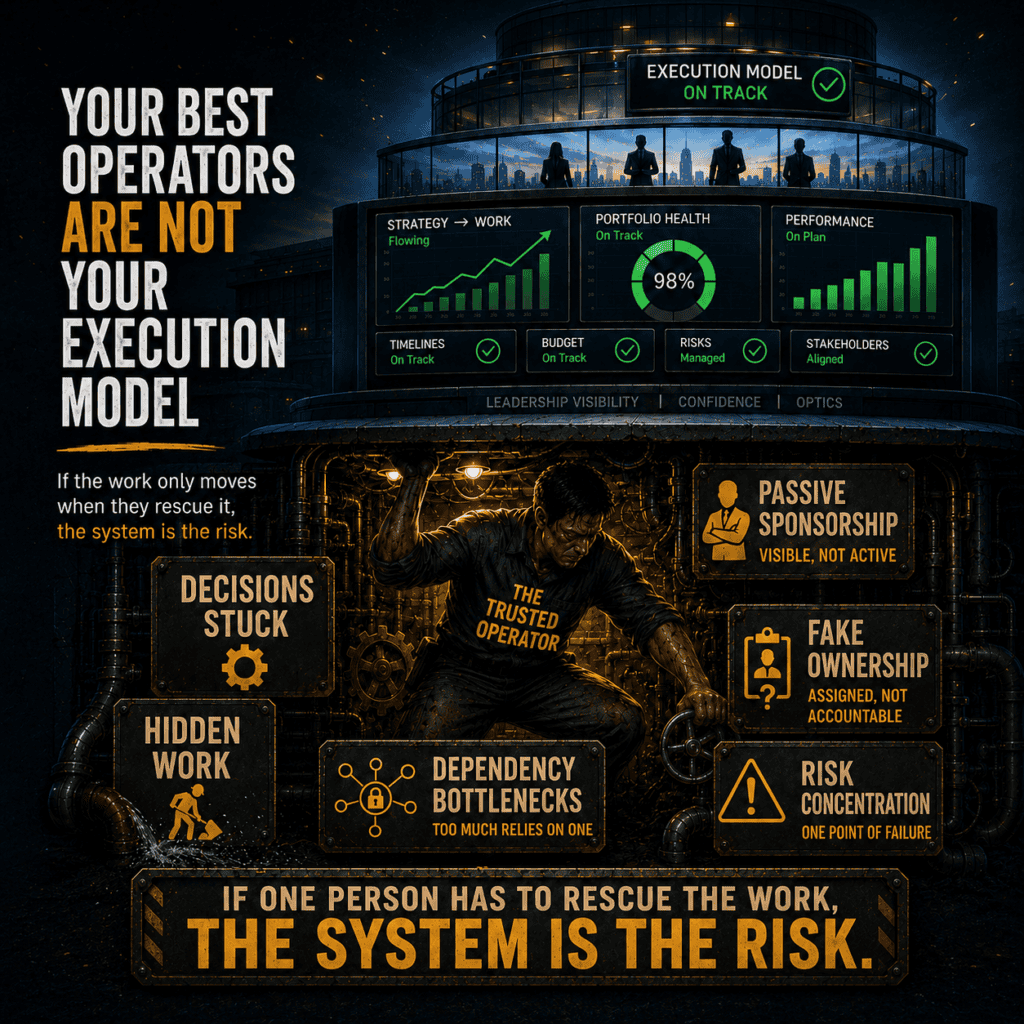
But too often, the business overuses them. Eventually, those people ARE the execution model.
That should concern every executive.
When the business depends on the same small group of people to translate strategy and stabilize troubled work, it doesn’t have a repeatable execution system.
It has execution heroics.
Heroics can save a moment, but they can’t scale a business.
The Pattern Executives Recognize But Rarely Name
This usually starts as a reasonable ask.
A program is behind, and someone says, “Pull her in. She’ll see what’s really going on.”
A decision is stuck across functions, and the team doesn’t need another meeting. It needs someone with enough context and credibility to force the actual tradeoff into the room.
Then there’s the steering committee version. The deck looks clean and the risks look managed. But the real issue is buried two layers down, so someone quietly asks the trusted operator to review it before leadership sees it.
The first few times, it works. The noise drops, and the real issue gets named. Now the sponsor has to make a call.
Then the workaround becomes the operating model.
Before long, the same people are attached to work they don’t own. They’re pulled into decisions that should already have a path. Leaders rely on them to connect strategy to execution because the formal system is not holding up.
At that point, the business is no longer using trusted talent well.
It’s using trusted talent to compensate for weak execution discipline.
Capable People Can Make Weak Systems Look Better Than They Are
This is the executive blind spot.
The work is moving, so leaders assume the model is working. The dashboard isn’t screaming, and the usual reviews keep happening.
But movement can be misleading.
Sometimes progress depends on a few people dragging work through gaps the system should be handling. The tracker may show an owner, but the real decision happens in the call before the meeting.
That’s where dependency hides.
On paper, the work looks governed, but in practice, progress depends on informal rescue between meetings.
A strong operator can make a fragile system look stable. That doesn’t make the system strong. It just means the business found someone willing to absorb the friction.
That’s not an execution model. It’s risk concentration.
“Who Owns It?” Is Not Enough
Ownership matters, but a lot of organizations confuse assignment with accountability.
A name goes into a tracker and a sponsor lands on the slide. The boxes are filled, so everyone feels better.
But a name in a tracker doesn’t create authority.
A sponsor who only shows up for updates doesn’t create momentum. A project lead sitting in the middle of the organization can’t fix a portfolio with more work than capacity.
That’s usually when the informal system takes over.
The real path to a decision often lies outside the tracker. By the time the meeting starts, the important work has already happened somewhere else.
That knowledge is valuable, but it shouldn’t be the only way work moves. The sharper question isn’t, “Who owns it?”
It’s “Who has the authority and capacity to move it when pressure hits?”
If the answer depends on one trusted person working around the system, the business doesn’t have accountability. It has an assignment with a workaround.
The Five-Person Test For Your Strategy Execution Model
There is a practical way to pressure-test this. Look at your highest-priority work from the last quarter and ask yourself these five questions:
- Which names keep showing up when execution gets hard?
- What decision can’t move without them?
- Where are relationships replacing authority?
- What critical knowledge exists only in someone’s head?
- What friction are they absorbing that leadership should own?
If the same names keep appearing, gratitude is not enough. Ask what the business is relying on those people to compensate for. That answer will show you where the execution model is fragile.
What Leaders Should Do Differently
Praise the operator. Then fix the reason the business needed that level of rescue.
Stop treating your best operators like spare capacity.
When the same person keeps getting pulled into unclear work, read that as evidence. The business is showing you where the operating model can’t carry execution on its own.
That person is not the fix. The repeated rescue is the signal.
Look at the work they keep getting pulled into. The pattern usually points to the same issue: leaders are asking the work to move without clearing the conditions required to move it.
That’s where leaders need to intervene.
Don’t design around the trusted person. Redesign around the friction their involvement keeps exposing. Unclear work shouldn’t enter the portfolio just because someone powerful wants it there.
Passive sponsorship shouldn’t pass as support.
Capacity concerns should be treated as operating constraints, not complaints from teams that need to “figure it out.”
Strong operators belong in important work. They should build capability across the business, not rescue the same preventable breakdowns every quarter.
When the same person keeps getting pulled in, look at what changed once they got involved.
- What did they make clear?
- Which decision finally moved?
- Where did the process miss the real issue?
Build that learning into how the business runs. That’s how organizations move from heroics to real execution capability. Not by celebrating the same people again, but by fixing the conditions that keep making their rescue necessary.
Final Thought
Your best operators can make a weak execution system look functional longer than it should.
That’s why leaders miss the risk. The deck gets cleaner because the work keeps moving, so it feels like the model is holding.
It may not be.
The business may be borrowing execution strength from people it’s slowly wearing down.
That’s not a talent strategy. It’s a hidden liability.
At some point, leaders have to stop asking their best people to carry what the organization hasn’t built the discipline to manage.
If the same few people keep getting pulled in every time execution gets hard, take the signal seriously. The issue isn’t that your best people are involved. The issue is that the work cannot move without them.
Fix it while they’re still engaged.
Once your best operators stop protecting the company from its own execution gaps, the truth doesn’t disappear.
It gets expensive.
About the Author
This article was written by Erica Howard, Chief Strategy Officer at Peoplyst and former Fortune 100 strategy and governance executive. Erica has more than 25 years of experience helping organizations strengthen strategy execution, portfolio governance, value realization, and operating model design across high-stakes priorities. She is known for building practical execution systems that connect strategy, prioritization, funding, accountability, governance, and measurable business outcomes.
Fact Checked & Verified
This content is part of Peoplyst’s commitment to practical, accurate guidance. You can find more of Erica Howard’s insights on LinkedIn or learn more about Peoplyst’s approach on our Strategy Execution and Value Realization page.
Have a question about how this applies to your business, or want to discuss how Peoplyst can help?
Schedule a brief strategy call with Erica.