
The company announces it’s time for a transformation in the business.
A sponsor is named, workstreams launch, and the dashboard starts filling up. Everyone gets busier, but the business does not get meaningfully different.
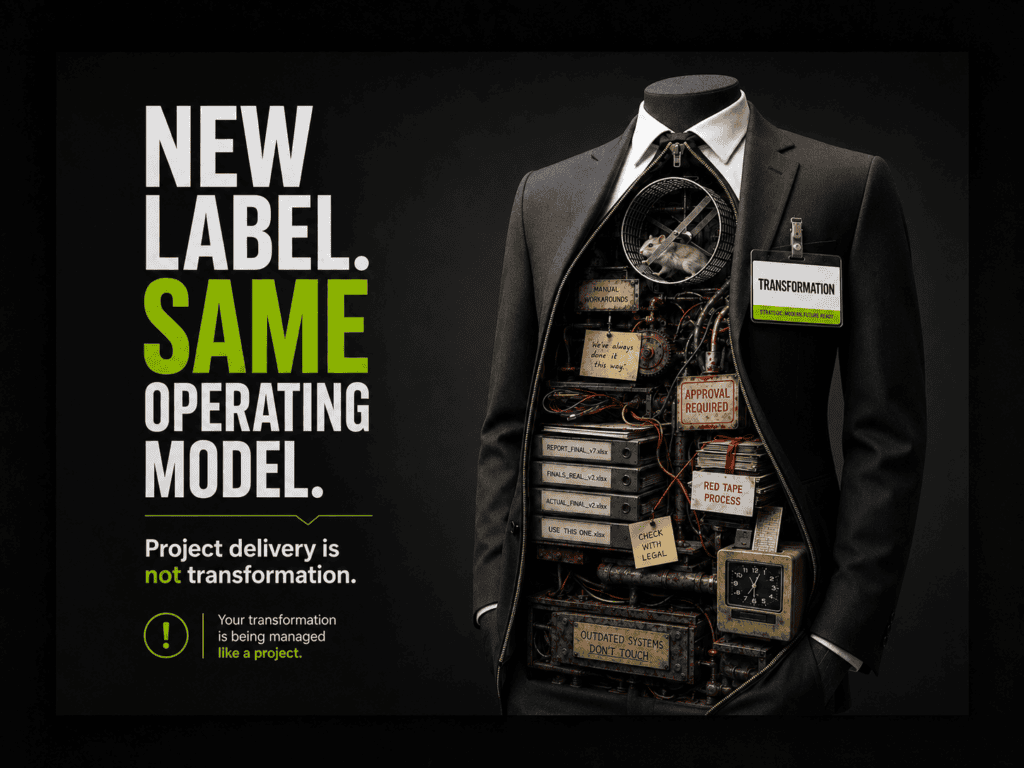
I’ve seen this pattern too many times to mistake it for a delivery problem. The work was labeled transformation, but then managed like a regular project.
Project delivery isn’t transformation. A project can be delivered, but a transformation has to change how the business runs.
That line gets blurred inside companies all the time. Leaders use transformation language, but the conversation still comes back to time, budget, scope, and whether the work looks controlled.
Those mechanics matter because execution still needs control. Leaders need visibility into the work, the blockers, the dependencies, and the capacity being consumed.
Size Doesn’t Make Work Transformational
Transformation gets overused because it sounds strategic.
I’ve seen large budgets, board visibility, steering committees, major platforms, and multi-year roadmaps produce very little operating change. The work looked important, but the business still found a way to run the same.
The better questions are the ones leaders usually ask too late:
- What changes in the business after the work lands?
- Have leaders changed what they review?
- What work comes out of the system?
- Are customers or employees experiencing something better?
- Can the operating model hold under pressure?
Those are the questions that keep leaders honest.
They start with the work plan, build workstreams, assign owners, define milestones, and put a cadence in place. Then the business case sits off to the side like a document everyone agrees with, but no one actively manages.
That’s how transformation turns into activity management.
The work gets managed, but the business never changes its operating rhythm.
The Project Plan Creates Comfort
A project plan gives leaders a sense of control: dates, owners, dependencies, and a path to completion.
When the work is complex and expensive, that structure feels responsible. It often is. But it can also make leaders too comfortable.
I’ve watched initiatives launch cleanly and still miss the business result because the conversation never moved past delivery. The team can explain whether the work is on track, whether the budget still holds, where the risk is sitting, and what milestone comes next.
Those explanations belong in the room. They just can’t be the only conversation.
Delivery predictability is the price of entry. It’s not the finish line.
Transformation work requires a different conversation before the plan gets too far ahead of the business.
- Where will the business feel the change first?
- What old work has to come out of the system?
- Who loses capacity during the transition, and who gets relief?
- Which leadership habits would pull the business backward?
- Who is still accountable when the project team is gone?
When those questions are missing, launch becomes the headline. Value realization gets pushed into the future, where no one is clearly accountable for it yet. The work looks successful, but the business results start slipping.
Go-Live Is Where The Work Leaves The Plan
Go-live gets attention because it’s visible.
The system goes live. A new process gets announced. The integration milestone is marked complete. Then the project structure starts to fall away.
This is where the clean version of the change meets the business as it actually runs. Customers are waiting. Teams are under pressure. Controls get tested in real work, not in a design session. The people being asked to trust the new data still remember exactly why the workaround existed in the first place.
That’s where many transformations weaken. The organization planned for delivery, but underbuilt absorption.
A few town halls and a training module will not carry that load. Communication may explain the change. Training may introduce the mechanics. Neither proves the business can run differently when pressure hits.
Adoption has to be managed after launch, when the business starts showing what works, what gets bypassed, and where the change is too heavy to hold.
By then, the project team is already moving on, the steering committee has less reason to meet, and another priority is already pulling attention away. The business is left with the change, but not enough ownership or capacity to make it hold.
Then leaders ask why the business case hasn’t materialized. The answer is usually not in the launch plan. It’s in whether the operating model actually changed.
The work was delivered. The business was left to absorb it.
Capacity Tells The Truth
Transformation doesn’t happen beside the business. It lands on a business that’s already running hot.
The sponsor still has a business to run. Subject matter experts are keeping the current operation moving. The managers expected to drive adoption are already buried in customer issues, performance gaps, hiring pressure, compliance demands, and daily escalation.
Then the plan quietly assumes they have room, but they don’t.
From the outside, this can look like resistance. Teams move slowly. Managers reach for familiar routines. The business seems reluctant to let go.
Sometimes that’s true.
More often, nothing meaningful has come out of the system. The same people are expected to run today’s business and build tomorrow’s at the same time.
The strain rarely announces itself. A decision waits another week. The same expert gets pulled into one more meeting. A risk everyone saw coming lands late. Managers go back to the familiar process because it gets them through the day.
The dashboard can still look acceptable because the strain is sitting outside the status report.
Then the cost shows up in the business through measures such as missed value, turnover, customer friction, and control risk. Teams that stop believing leadership understands what execution really requires.
Governance Has To Follow The Transformation Value
Most transformations have governance, but that doesn’t mean leaders are managing the right thing.
During the build phase, that’s appropriate. Leaders need visibility into progress, spend, risk, and the few issues that could slow the work down. The meeting should help them act before the plan gets away from them.
The problem starts when governance stays there too long.
The business moves into absorption, but the meeting keeps asking project questions. After launch, the governance conversation should change.
- Is the metric that justified the investment actually moving?
- Where is friction still showing up in the business?
- What issues keep getting explained instead of resolved?
- Which benefits are being claimed before they show up in the results?
- What is leadership learning after launch that should change the next decision?
That’s the governance gap in many transformations. The cadence keeps tracking completion when it should be tracking absorption.
I’ve seen this happen with systems, integrations, operating model changes, and remediation work. The work gets marked complete, but leaders don’t stay close enough to see whether the business is actually running differently.
That’s how a clean launch becomes a weak result.
Governance has to follow the value past delivery. Early on, it should control the work. Later, it should protect the business result.
That may require different measures, different owners, and a different tolerance for uncomfortable information. A green project status means very little if adoption is weak, customers are frustrated, controls are being bypassed, or the old process is still doing the real work.
Transformation governance should surface those facts while leaders still have room to act. Otherwise, leaders get a clean update while the value keeps moving out of reach.
People Carry The Operating Change
I get concerned when transformation plans treat people impact like a communication workstream. That’s too narrow.
People are where the new operating model either holds up or breaks down. They decide how exceptions get handled, which rules get followed, what customers experience, and whether the new way of working can survive a busy Tuesday.
This is why training alone is not enough. A team can understand the new process and still be unable to run it well because the role design is unclear, the manager is not equipped, or the incentives still point backward.
The people questions should sound like business questions.
- Which roles become harder after this change?
- Where are capability gaps going to slow execution?
- Who is being asked to lead through a model they haven’t had time to learn?
- Which teams are carrying transition work without relief?
- What incentives still make the old behavior rational?
- Which informal experts are holding the change together without relief?
People follow the path that gets the work done, protects the customer, and keeps the day moving. When the new model doesn’t support that, the prior operating rhythm doesn’t disappear. It stays alive inside spreadsheets, exception paths, shadow approvals, and the judgment of the people who know how the business really runs.
That’s how the old business keeps operating underneath the new one.
Calling It Transformation Raises The Standard
Leaders should be careful with the word transformation.
Calling something a transformation creates a promise. People expect disruption to lead somewhere. Customers may feel the friction. Boards expect the value to show up.
So the management standard has to be higher.
A transformation can’t be treated as complete when the project team finishes its part. Leaders have to stay close enough to see whether the business can run the new way when customers are waiting, and the workaround still feels faster.
That’s where the truth shows up.
The process may be live, but managers may still be approving exceptions around it. The system may be launched, but teams may still be keeping their own files because they don’t trust the data. The operating model may be announced, but decisions may still climb to the same few people.
That’s the current business protecting itself.
No one needs to announce that the transformation missed. The business will show it in slower decisions, weak adoption, missed value, and the quiet return of habits the initiative was supposed to eliminate.
A project can end with delivery. A transformation has to make the prior path harder to use than the new one.
Until the new way is how the business actually runs, leaders should be cautious about declaring victory.
The deck can say complete, but the business will decide whether anything changed.
About the Author
This article was written by Erica Howard, Chief Strategy Officer at Peoplyst and former Fortune 100 strategy and governance executive. Erica has more than 25 years of experience helping organizations strengthen strategy execution, portfolio governance, value realization, and operating model design across high-stakes priorities. She is known for building practical execution systems that connect strategy, prioritization, funding, accountability, governance, and measurable business outcomes.
Fact Checked & Verified
This content is part of Peoplyst’s commitment to practical, accurate guidance. You can find more of Erica Howard’s insights on LinkedIn or learn more about Peoplyst’s approach on our Strategy Execution and Value Realization page.
Have a question about how this applies to your business, or want to discuss how Peoplyst can help?
Schedule a brief strategy call with Erica.